


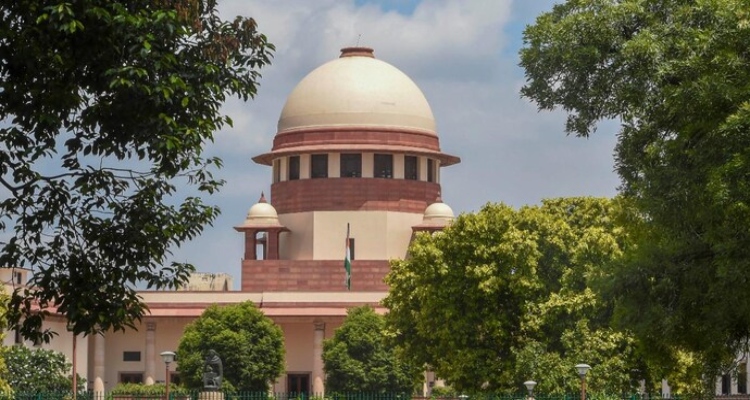
In a significant move to streamline legal proceedings, the Supreme Court has ordered the transfer of all petitions challenging the results of the Common Law Admission Test (CLAT) 2025 to the Delhi High Court.
This decision aims to ensure consistent and expedited adjudication of the numerous cases filed across various high courts in the country.
Background
The CLAT 2025, conducted on December 1, 2024, is a pivotal examination for admissions into undergraduate and postgraduate law programs across National Law Universities (NLUs) in India. Following the release of results on December 7, 2024, several candidates raised concerns over alleged errors in the answer key, leading to multiple petitions in high courts including those of Karnataka, Madhya Pradesh, Calcutta, Bombay, and Punjab & Haryana.
Court’s Directive
A bench comprising Chief Justice Sanjiv Khanna and Justices Sanjay Kumar and K.V. Viswanathan acknowledged the potential for conflicting judgments due to the dispersed nature of the petitions. To mitigate this, the Court directed that all existing and future petitions related to CLAT 2025 be consolidated and heard by a division bench of the Delhi High Court. The registrars of the respective high courts have been instructed to transfer all relevant judicial records to the Delhi High Court within seven days.
Previous Developments
The Delhi High Court had earlier addressed similar concerns when, on December 20, 2024, a single judge ruled that errors in two questions of the CLAT UG 2025 exam were evident and ordered the Consortium of NLUs to revise the results accordingly. This decision was subsequently challenged by both the Consortium and the petitioners, leading to further legal scrutiny.
The court has scheduled the hearing of these consolidated petitions for April 7, 2025. The court has emphasized the importance of a swift resolution, acknowledging the anxiety and uncertainty faced by students awaiting clarity on their admissions. The Consortium of NLUs has been directed to respond to the petitions within three weeks.
This consolidation is expected to provide a uniform platform for addressing the grievances of CLAT 2025 aspirants and ensure a fair and timely resolution to the disputes surrounding the examination results.
Read More: Supreme Court, Delhi High Court, States High Court, International