


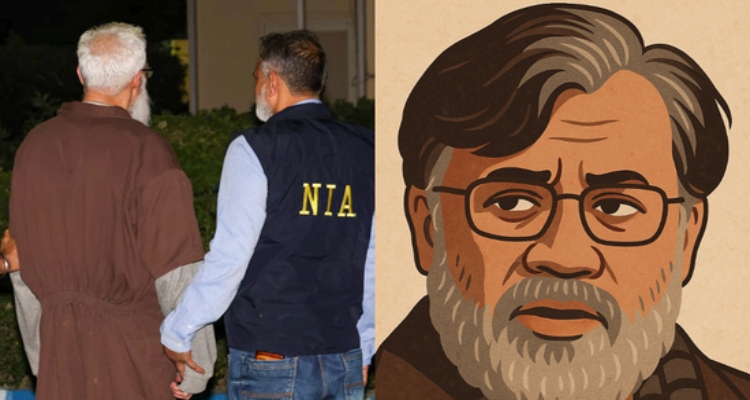
The special NIA Judge Chander Jit Singh has recently granted the National Investigation Agency’s (NIA) petition to obtain both voice and handwriting samples from Tahawwur Rana.
Rana—accused of orchestrating the 26/11 Mumbai attacks—remains in NIA custody after his recent extradition from the United States.
Remand Extended To Deepen Interrogation
Earlier this week, the same courtroom approved a further 12-day extension of Rana’s custody. During the hearing, the NIA outlined that it had shown Rana an extensive set of documents and evidentiary materials linked to the 2008 Mumbai siege.
The agency maintained that “further custody was necessary to complete his interrogation.” Prosecutors emphasized Rana’s reluctance to cooperate, describing him as “evasive during questioning” and “not cooperating with the investigation.” They argued that only additional custodial interrogation would yield the critical details needed to map out his alleged contributions to the attack’s planning and logistics.
Counsel & Contentions
Representing the NIA, Senior Advocate Dayan Krishnan and Special Public Prosecutor Narender Mann urged the bench for more time to question the 64-year-old suspect. On the opposing side, Advocate Piyush Sachdeva, appointed by the Legal Services Authority, contested the extension. Rana’s defense counsel argued that prolonging his remand lacked justification and that further detention violated his rights.
From Extradition To New Delhi Custody
Tahawwur Rana, a Canadian national of Pakistani descent, was flown to India after U.S. authorities approved his extradition earlier this month. Upon arrival, he was immediately placed under NIA supervision in New Delhi, where investigators have launched a detailed probe into his alleged nexus with Lashkar-e-Taiba operatives. The agency’s strategy includes matching Rana’s handwriting to seized documents and comparing his voice with intercepted calls and recordings.
Recalling The 26/11 Carnage
The 26/11 assault, carried out by Lashkar-e-Taiba militants, unfolded over nearly three days and targeted iconic Mumbai landmarks, such as the Taj Mahal Palace Hotel, Oberoi Trident, and Chhatrapati Shivaji Terminus. More than 170 people lost their lives, and hundreds were wounded in one of the deadliest terrorist episodes in India’s history. The coordinated strikes shocked the nation and prompted sweeping reforms in India’s counterterrorism apparatus.
Forensic Steps & Future Proceedings
Now empowered to collect Rana’s biometric and forensic samples, the NIA plans to dispatch experts immediately. Voice prints will be analyzed against recorded communications, while handwriting experts will examine suspects’ notes and letters. Officials believe these analyses will yield irrefutable links between Rana and the operational planners of the Mumbai attack.
The move to secure Rana’s samples underscores India’s resolve to dismantle every strand of the 26/11 conspiracy. Investigators are determined to hold all facilitators and masterminds legally accountable.
As proceedings continue, the NIA has reiterated its commitment to completing a thorough, transparent investigation, ensuring justice for the hundreds of victims and their families.
This approval for sample collection—and the extended remand—marks a pivotal moment in unraveling the complexities behind the 26/11 tragedy and bringing all involved parties to justice.
Read More: Supreme Court, Delhi High Court, States High Court, International