


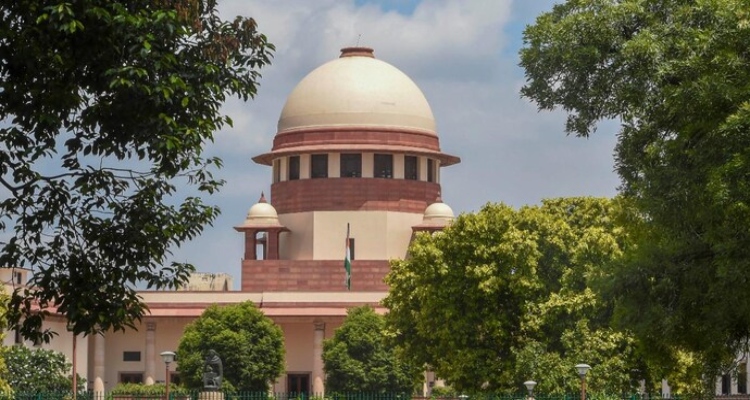
The Supreme Court on Friday upheld the Tata Institute of Social Sciences’ decision to suspend PhD candidate Ramadas K.S. for alleged misconduct and “anti-national” activities—but trimmed the suspension period to the time he has already served.
A bench of Justices Dipankar Datta and Manmohan refused to overturn TISS’s April 17, 2024 order, which had slapped Ramadas with a 2-year suspension and barred him from all campus premises.
However, the court held that since Ramadas is in the midst of a doctoral programme, he should be permitted to complete his research. As a result, the two-year ban now expires immediately, covering only the interval between April 17, 2024, and May 2, 2025.
Grounds For Suspension
An “empowered committee” at TISS found Ramadas guilty of violating the institute’s honour code, rules, and regulations. The committee cited his participation in a protest at Jantar Mantar in Delhi, and his role in organising a public screening of a documentary on the Ayodhya dispute, as examples of “politically motivated” conduct unbecoming of a scholarship recipient. Ramadas had been awarded a Central government–funded fellowship for Scheduled Caste students based on his UGC-NET performance.
Court’s Arguments
Ramadas challenged the suspension before the Bombay High Court, contending that the punishment was excessive and infringed his academic rights. On March 12, however, the Bombay High Court upheld the two-year ban as “proportionate” and “based on material available on record,” finding no illegality or perversity in the empowered committee’s report.
In the Supreme Court, Advocate Rajeev Kumar Panday represented TISS, arguing that the institute lawfully exercised its disciplinary powers. He urged the court to respect the Bombay High Court’s order, pointing to evidence of Ramadas’s alleged misconduct.
Court’s Reasoning
While the Supreme Court agreed that the suspension itself was justified, Justices Datta and Manmohan noted Ramadas’s ongoing scholarly pursuits. They emphasised that depriving a research student of campus access indefinitely could derail his PhD. Granting relief in part, the bench held that:
“In the … facts and circumstances, having ourselves considered the material on record, we do not find that the impugned committee report suspending the petitioner for two years suffers from any perversity or illegality. … We find that this is not a fit case to interfere.”
By limiting the ban to the period already served, the Supreme Court balanced institutional discipline with the scholar’s right to education.
Academic Journey of Ramadas K.S.
2015: Enrolled in TISS’s Master’s in Media and Cultural Studies; received a Ministry of Social Justice and Empowerment scholarship.
2017–18: Joined the integrated MPhil–PhD programme in Development Studies.
2021: Completed the MPhil component.
February 8, 2023: Awarded a national fellowship for Scheduled Caste scholars based on UGC-NET results.
Read More: Supreme Court, Delhi High Court, States High Court, International