


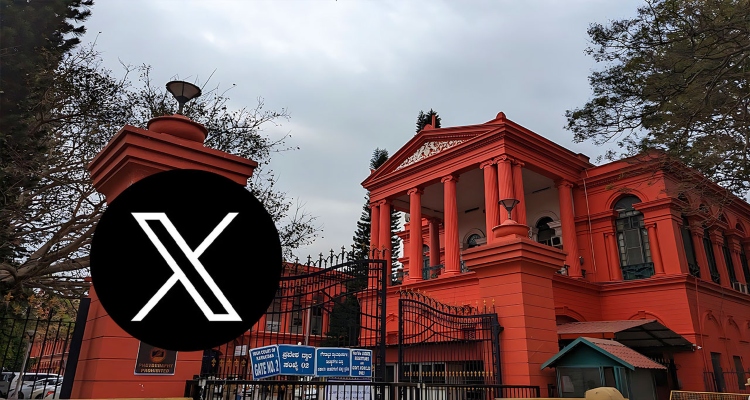
In a significant hearing at the Karnataka High Court, X Corp (formerly Twitter) argued that Section 79 of the Information Technology Act allows government officers to block online content without any institutional checks, raising concerns over arbitrary enforcement.
Senior Advocate K G Raghavan, representing X Corp, told Justice N Nagaprasanna that thousands of government officials have been empowered by the Union government across different jurisdictions to issue takedown orders under Section 79. Each officer interprets what qualifies as “unlawful” or “immoral” content based on personal discretion, leading to inconsistent actions.
“Unlike Section 69A, which requires a structured committee process with reasons recorded in writing, Section 79 permits individual officers to block content unilaterally without oversight,” Raghavan submitted. “This results in arbitrary enforcement that violates Article 14 of the Constitution,” he added.
He further explained that Section 79(3)(b), frequently cited to justify takedown orders, does not independently grant the executive power to block content. If it is to be considered such a source of power, it must be read alongside the more procedural Section 69A.
“Can a government officer pass a blocking order from their office without any oversight? The answer is no. Such a regime reduces law to personal opinion — ‘I say so, therefore it is so,’” Raghavan said, warning against the “opaqueness and arbitrariness” inherent in the current system.
Highlighting the subjectivity, he noted that what may be offensive in one region can be culturally accepted elsewhere, underscoring the dangers of unregulated discretion.
X Corp clarified it does not seek immunity from Indian law but insists on procedural safeguards that are missing under Section 79 yet mandated under Section 69A. Raghavan warned that the current interpretation could expose the platform to criminal and civil liability under provisions like Section 45 of the IT Act.
Referring to a Supreme Court judgment, he stressed that the same freedom of expression standards must apply uniformly across all media, including digital platforms. However, Justice Nagaprasanna observed that the ruling cited pertained to the 2011 IT Rules, which have since been replaced by the 2021 IT Rules — a framework not yet examined by the Supreme Court.
Responding, Raghavan cited a Bombay High Court decision striking down parts of the 2023 amendments to the IT Rules, particularly concerning Fact Check Units. He challenged Rule 3(1)(d) of the 2021 Rules, which allows government direction to intermediaries for content removal, calling it violative of separation of powers and lacking safeguards, urging the court to strike it down.
While foreign entities like X Corp are not covered under Article 19’s free speech protections, Raghavan argued Article 14’s guarantee of equality before law does apply. Laws failing procedural fairness tests under Article 14, he contended, must be struck down regardless of nationality.
Opposing these submissions, Solicitor General Tushar Mehta said X Corp’s arguments were overly “X-centric,” stressing the government must also consider the complainants’ rights and the platform’s nature.
“If defamatory content is posted and intermediaries do not act, the victim has no immediate remedy. Traditional media like the Times of India are accountable. Shouldn’t intermediaries enjoying safe harbour protection under Section 79(1) also have responsibilities?” Mehta asked.
The court heard arguments through the day and scheduled the next hearing for July 11, with the Centre set to file its full response by July 17.
Read More: Supreme Court, Delhi High Court, States High Court, International