


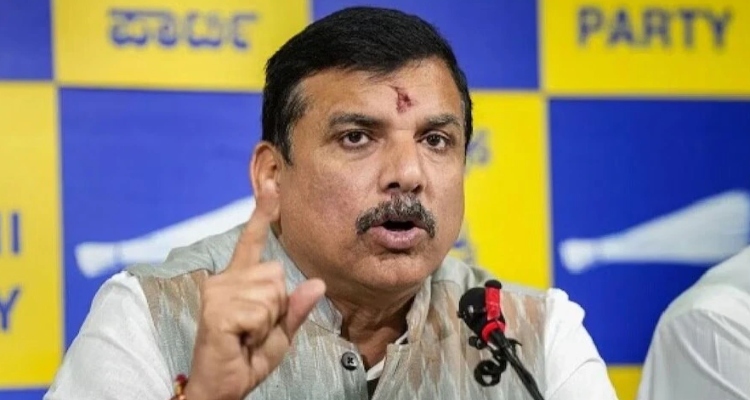
The Supreme Court on Monday dismissed as withdrawn a petition filed by Aam Aadmi Party (AAP) Rajya Sabha MP Sanjay Singh challenging the Uttar Pradesh government’s decision to shut down 105 government-run primary schools.
A bench of Justice Dipankar Datta and Justice A.G. Masih refused to entertain the plea, noting that similar matters are already pending before the Allahabad High Court.
Background Of The Closure Decision
The controversy began with a June 16 decision of the Uttar Pradesh government, followed by an order on June 24, to close 105 primary schools across the state. Officials argued that these schools had either no students or negligible enrollment, making them unsustainable.
Instead of outright shutdowns, the government said the institutions were being “paired” with nearby schools, in line with broader educational restructuring.
Challenging the move under Article 32 of the Constitution, Singh described the closure as “arbitrary, unconstitutional, and legally impermissible.”
The plea claimed that the decision would severely affect children’s fundamental right to education guaranteed under Article 21A and the Right of Children to Free and Compulsory Education (RTE) Act, 2009.
The petition highlighted Rule 4(1)(a) of the RTE Rules, which requires a primary school (Classes I–V) within one kilometre of every habitation with a population of at least 300. According to Singh, the state’s decision ignored this statutory mandate.
Adverse Impact On Marginalized Children
The petition stressed that children in the 6–11 age group, particularly those from Scheduled Castes, Scheduled Tribes, minority communities, and girls, would face the harshest consequences.
“Many parents have withdrawn their wards from schools due to safety concerns and logistical impossibilities, resulting in de facto denial of access to schools, and pushing children back into labour or domestic work,” the plea stated.
Clash With NEP 2020 Justification
The state justified the decision as part of policy restructuring and alignment with the National Education Policy (NEP) 2020, pointing out that many schools had negligible student strength.
However, Singh argued that such an executive action was ultra vires, as closures or mergers of schools already established under statutory provisions cannot be carried out through mere executive instructions.
“The impugned action has the effect of denying children access to education within the statutory neighbourhood limits and fails to make alternative arrangements as per the mandatory requirements under the Rules,” the petition stated.
Lack Of Consultation Alleged
The petition also claimed that the state acted without public consultation and ignored the statutory role of School Management Committees, as mandated under the RTE Act.
Representation Before Court
The petition was filed through Advocate-on-Record Sriram Parakkat on behalf of Sanjay Singh. The Uttar Pradesh government was represented by Advocate-on-Record Ankit Geol.
While the Supreme Court declined to step in at this stage, the fate of the 105 schools now hinges on the proceedings before the Allahabad High Court.
(Inputs By Sambhav Sharma)
Read More: Supreme Court, Delhi High Court, States High Court, International