


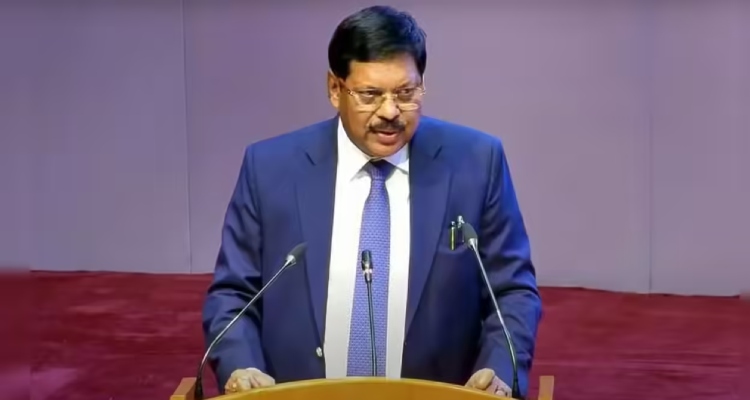
Chief Justice of India B.R. Gavai expressed satisfaction over the Supreme Court’s landmark ruling that barred the demolition of homes of accused persons without following due legal process.
Speaking at a felicitation function organized by the Goa High Court Bar Association in Panaji on Saturday, the CJI underscored the importance of protecting citizens’ rights and upholding the rule of law.
‘Executive Cannot Become A Judge’
Recounting last year’s judgment where the apex court strongly criticized “instant bulldozer justice,” CJI Gavai said the bench had laid down pan-India guidelines to ensure the government does not act as judge and jury.
“I am really happy that we could do something as a custodian of the Constitution for protecting the rights of citizens whose houses were demolished without following the procedures of law,” he said.
The CJI noted that houses were being razed even before trials began, forcing innocent family members to suffer. “Even if a person is convicted, he is still entitled to the rule of law,” he added, emphasizing that the rule of law is paramount in India.
Separation Of Powers Must Be Respected
Highlighting the constitutional principle of separation of powers, CJI Gavai warned against executive overreach.
“The executive cannot be permitted to be the judge; if that happens, we will be hitting at the very concept of separation of power,” he said.
CJI Gavai also spoke about his widely debated judgment on sub-classification within Scheduled Castes. He revealed that people from his own community had criticized him for it, but stressed that his decisions were guided by law and conscience—not popular opinion.
“I always believed that I have to write my judgment not by demands or desires of the people, but as per the law that I understand and as per my own conscience,” he remarked.
Unequal Cannot Be Treated As Equal
Explaining the rationale behind the verdict, the CJI observed that benefits of reservation often extend to multiple generations.
“When a first-generation individual from a reserved category becomes an IAS officer, the benefit often goes to the 2nd and even 3rd generation,” he said.
He questioned whether children from elite backgrounds in cities could be treated on par with those of daily wage laborers in rural areas.
“Article 14 does not mean equality among unequals. What is contemplated is unequal treatment to unequals so that they become equals,” he said, adding that equating a child of a chief secretary with one studying in a village Zilla Parishad school “hits at the very concept of equality.”
Read More: Supreme Court, Delhi High Court, States High Court, International