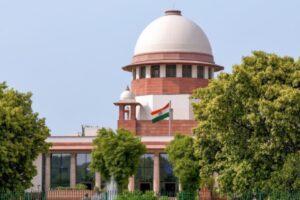




The Congress-led Telangana government on Wednesday informed the Supreme Court that the governor is, in general, bound by the aid and advice of the council of ministers when dealing with the grant of prosecution sanction, except in cases where a minister or the chief minister is personally involved in a criminal matter.
Senior advocate Niranjan Reddy, representing the Telangana government before a 5-judge Constitution bench headed by Chief Justice of India BR Gavai, argued that while answering the Presidential reference, the court must also examine the inherent bias that may arise if a governor delays action, as seen in certain states.
Concerns Over Governors Sitting On Bills
Referring to a recent situation in Tamil Nadu, where the governor delayed acting on a bill passed by the state assembly to remove the governor’s role as chancellor of state-run universities, Reddy urged the bench to take note of the governor’s conduct.
He emphasized that such instances highlight how discretion, when unchecked, could result in partisan or biased decision-making.
The bench — which also includes Justices Surya Kant, Vikram Nath, PS Narasimha, and AS Chandurkar — was informed that the second proviso under Article 200 indicates that governors ordinarily have no discretion and are bound to act on the council of ministers’ advice, except under exceptional circumstances.
Article 200 Under Scrutiny
The court is currently hearing a Presidential reference on whether judicial timelines can be imposed on governors and the President while dealing with bills passed by state legislatures. Article 200 grants governors the power to either assent to a bill, withhold assent, return the bill for reconsideration, or reserve it for the President’s consideration.
The court is also examining whether constitutional authorities can indefinitely withhold assent and whether courts can mandate timelines for processing such bills.
Arguments From Opposition-Ruled States
States governed by opposition parties have opposed the Presidential reference, calling it an overreach. The court’s earlier observation that governors must act within a “reasonable time” even when the phrase “as soon as possible” is not explicitly mentioned in the Constitution drew attention to the issue.
Senior advocate Arvind Datar, representing Punjab, argued that the inclusion of “as soon as possible” by the Constitution’s framers shows that timelines can be judicially enforced. Similarly, K K Venugopal, representing Kerala, cited the example of former Governor Arif Mohammad Khan, who sought briefings from ministries upon receiving bills.
The Karnataka government contended that under the constitutional scheme, governors and the President are titular heads, required to act on the advice of ministers both at the state and central levels.
Read More: Supreme Court, Delhi High Court, States High Court, International