


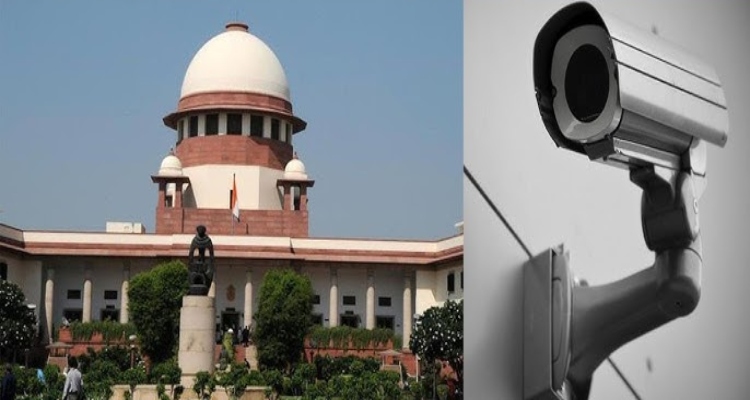
The Supreme Court on Monday explored the possibility of creating fully automated control rooms to monitor CCTV cameras in police stations, aiming to eliminate human intervention that could allow tampering or disabling of cameras.
The bench suggested that technology may be the most effective safeguard against manipulation of surveillance systems.
During the hearing, Justices Vikram Nath and Sandeep Mehta discussed how police stations sometimes turn off cameras or delete footage to cover misconduct. Justice Mehta remarked, “We were thinking of a control room in which there is no human intervention. So all feeds are provided to the control room. Any camera goes off, there is a flag. That is the way this thing can be tackled. There is no other way.”
The Court also considered involving independent technical experts, such as those from the Indian Institute of Technology (IIT), to design and implement such systems. Justice Mehta added, “Initially, there has to be inspections of police stations also by an independent agency… Even monitoring should not be human.”
Trigger For The Case
The case was initiated by the Court itself after a report by Dainik Bhaskar exposed 11 custodial deaths over the last several months in police stations lacking functional CCTV coverage. The absence of working surveillance raised fears of unchecked abuse of power and lack of accountability.
This issue follows the Supreme Court’s earlier 2020 directive in Paramvir Singh Saini v. Baljit Singh & Others, which mandated the installation of CCTV cameras with night vision in all police stations nationwide. The Court also instructed the central government to equip interrogation facilities of agencies like the CBI, NIA, ED, and others with proper surveillance mechanisms.
Compliance Still A Concern
Senior Advocate Siddhartha Dave presented the Court with affidavits from various States and Union Territories, some complying with the directives and others lagging behind. The bench observed, “The issue is of oversight. Today there is a compliance affidavit, tomorrow, a police officer switches off or diverts the cameras. In that case, what happens?”
Dave further pointed out that the central government itself had not fully implemented the orders. “The glaring fact is that the Union of India, which has 2–4 investigation agencies, hasn’t complied… I can assist your lordship in this matter also,” he told the Court.
Looking Ahead
Court has set the matter for final orders on September 22. It is likely to consider how technology-driven oversight can strengthen policing and prevent manipulation of evidence.
Read More: Supreme Court, Delhi High Court, States High Court, International