

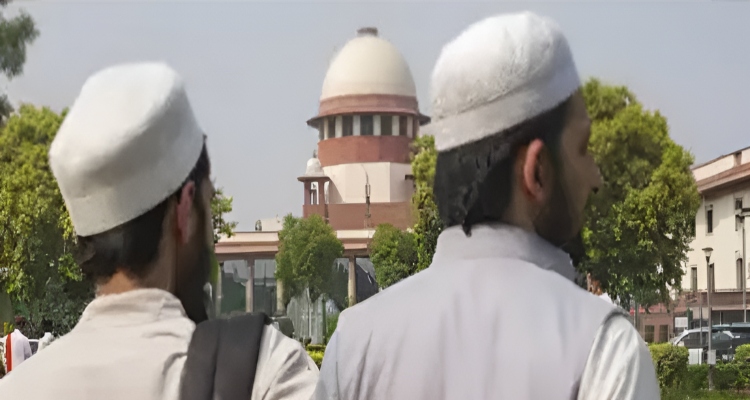
The Central Government on Thursday assured the Supreme Court that it will not denotify any waqf properties, including those classified as “waqf by user”, nor make any new appointments to the Central Waqf Council and state waqf boards until May 5.
The assurance was given by Solicitor General Tushar Mehta during a hearing before a bench comprising Chief Justice Sanjiv Khanna, and Justices Sanjay Kumar and K V Viswanathan. The court is currently hearing petitions challenging various provisions of the Waqf Act.
Centre Seeks Time, Opposes Interim Relief
Solicitor General Mehta urged the court not to pass any interim orders without hearing the government in detail. He emphasized that the Waqf Act had been passed by Parliament after careful deliberation and therefore, should not be stayed hastily.
In particular, the Centre opposed the Supreme Court’s proposal to temporarily restrain the denotification of waqf properties and suspend the controversial provision that allows non-Muslims to be appointed to the Waqf Board and Central Waqf Council.
“This law has been enacted by Parliament with due discussion. Interim orders should not be passed without hearing us,” Mehta told the bench.
SC Grants One Week For Response
Taking note of the Centre’s stand, the Supreme Court granted the Union Government seven days to file its detailed reply to the petitions. The matter will be taken up again after the Centre submits its affidavit.
In the meantime, the government’s assurance means no waqf property — including those claimed under “waqf by user” (a controversial category based on long-standing usage rather than formal endowment) — will be denotified, and no fresh appointments will be made to the waqf bodies.
Background Of Case
The case revolves around petitions challenging the constitutional validity of certain provisions in the Waqf Act, including those that allow for broad classification of waqf property and provisions that permit non-Muslims to hold positions in waqf management bodies.
The petitioners argue that such provisions violate religious rights and the principles of secularism. The government, however, maintains that the law is constitutionally sound and was enacted after comprehensive debate.
The case is being closely watched for its potential impact on the administration of religious properties and the balance between religious autonomy and state regulation.
Read More: Supreme Court, Delhi High Court, States High Court, International