



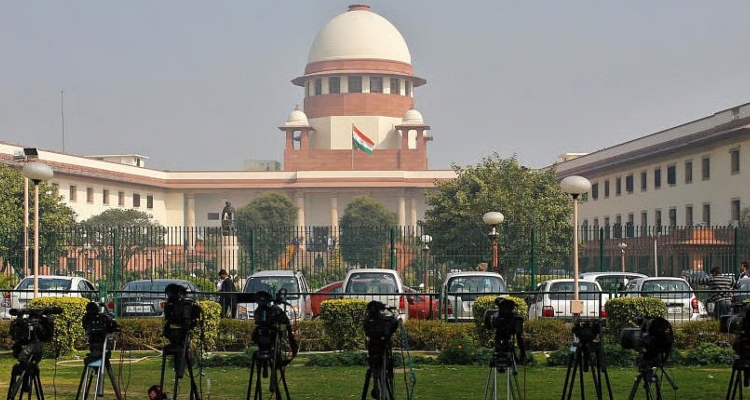
The Supreme Court on Tuesday began hearing a crucial constitutional question: “Can judicial officers who had practiced as advocates for 7 years before joining the bench apply for district judge posts under vacancies reserved for the Bar?”
A 5-judge Constitution Bench led by Chief Justice BR Gavai and comprising Justices MM Sundresh, Aravind Kumar, SC Sharma, and K Vinod Chandran took up the matter. In all, 30 petitions challenging earlier judgments have been clubbed together, with the outcome expected to significantly impact judicial recruitment nationwide.
What Article 233 Says?
The issue revolves around the interpretation of Article 233 of the Constitution, which governs the appointment of district judges.
It provides that “Appointments are made by the Governor in consultation with the High Court.”
A person “not already in service of the Union or State” is eligible for district judge posts if he or she has been an advocate for at least 7 years and is recommended by the High Court.
The controversy arises when judicial officers, who were advocates for 7 years before joining the judiciary, seek to apply under the Bar quota.
Petitioners’ Arguments
Senior advocate Jayant Bhushan opened the arguments for a group of civil judges denied entry into direct recruitment for district judge posts.
He argued that many officers had completed the mandatory 7 years at the Bar before joining judicial service, yet were disqualified from applying under the Bar quota. Their challenges before different High Courts were dismissed, relying on past judgments.
Calling it a matter of “great constitutional importance,” Bhushan outlined 4 key questions before the bench:
Eligibility of Judicial Officers – Can a judicial officer who has completed 7 years at the Bar before joining service apply under Bar quota?
Stage of Assessment – Should eligibility be determined at the time of application, appointment, or both?
Separate Criteria – Does Article 233 prescribe distinct eligibility rules for persons already in judicial service?
Combined Experience – Can 7 years of combined experience as an advocate and judicial officer qualify a candidate?
Bhushan also cited the Indian Civil Services Act, 1861, and Constituent Assembly debates to trace the historical intent behind district judge appointments.
Bench’s Observations
The Constitution Bench noted that it must carefully examine whether combined experience at the Bar and in judicial service can be counted together.
However, the CJI cautioned against an interpretation that would “create a situation where a person with just two years’ practice becomes eligible,” underscoring the need to preserve the intent of Article 233.
Case Background
On August 12, a three-judge bench had referred the matter to a larger bench while hearing an appeal against a Kerala High Court judgment. Court had set aside the appointment of a district judge, ruling that he was not a practicing advocate at the time of appointment, despite having seven years of prior Bar experience.
The hearing before the Constitution Bench will continue till September 25.
Read More: Supreme Court, Delhi High Court, States High Court, International