



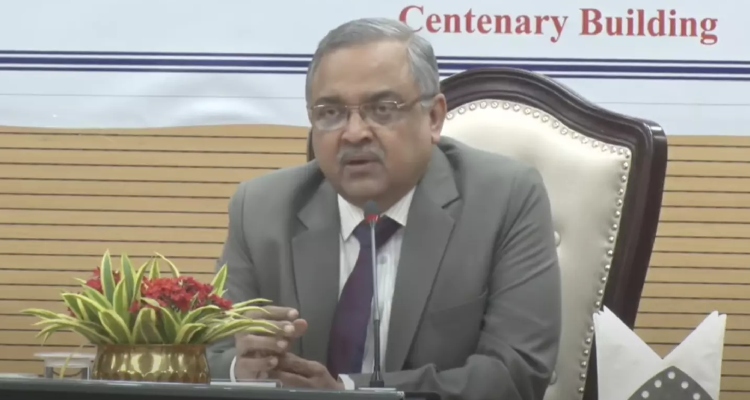
Supreme Court judge Justice K Vinod Chandran on Monday recused himself from hearing a plea challenging the appointment of Professor Naima Khatoon as Vice-Chancellor of Aligarh Muslim University (AMU).
Khatoon made history earlier this year as the first woman to hold the post at the 103-year-old institution.
The case, filed by Muzaffar Uruj Rabbani, questions the validity of her appointment. It was listed before a bench led by Chief Justice B.R. Gavai along with Justices Chandran and N.V. Anjaria.
Why Justice Chandran Recused
At the start of the proceedings, Justice Chandran volunteered to step aside, citing a potential conflict of interest from his earlier role as Chancellor of Chanakya National Law University (CNLU).
“I was the Chancellor of CNLU when I selected Faizan Mustafa… so I can recuse myself from the hearing,” he told the court.
While Solicitor General Tushar Mehta insisted there was no reason for recusal—“We have full faith in Justice Chandran. No recusal is needed, you can very much decide,” he said—the Chief Justice decided otherwise.
“Let my brother (Justice Chandran) decide. List this case before a bench to which Justice Chandran is not a part of,” the CJI directed, sending the matter to another bench.
Petitioner Flags Voting Irregularities
Appearing for the petitioner, senior advocate Kapil Sibal cast doubt on the fairness of the Vice-Chancellor selection.
“If this is the way Vice-Chancellors are appointed, I shudder to think what will happen in future,” he said. According to him, the outcome was shaped by two controversial votes, one of them cast by the outgoing Vice-Chancellor.
“She would have secured only 6 votes if those two are excluded,” Sibal submitted.
Government Defends Appointment
On the other hand, Additional Solicitor General Aishwarya Bhati defended Khatoon’s selection, stressing both its legality and significance.
“This is part selection and part election. The High Court may not have agreed with our election argument but it did uphold her appointment,” Bhati said, adding that the petitioner had not raised challenges against comparable appointments such as that of the Provost.
She dismissed the objections as being based merely on “apprehended bias.”
CJI’s Observation On Outgoing VC’s Role
Chief Justice Gavai, however, observed that the outgoing Vice-Chancellor should ideally have refrained from casting a vote in the process.
“Even in collegium decisions, if such a situation arises, we recuse ourselves,” he remarked, underlining the need for neutrality in decision-making.
With Justice Chandran stepping aside, the plea will now be heard by a different bench. The legal battle continues, as the petitioner presses for scrutiny of the selection process, even while Khatoon’s appointment remains a landmark moment for AMU.
Read More: Supreme Court, Delhi High Court, States High Court, International