


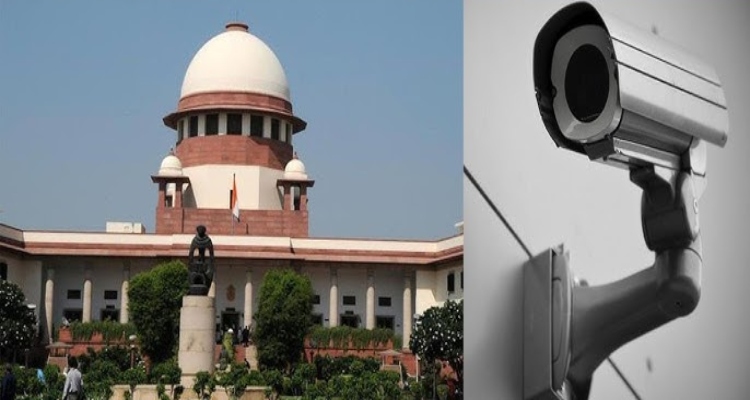
The Supreme Court has opened a fresh suo motu case after learning that many police stations across the country still lack working CCTV cameras, despite years of judicial directions aimed at checking custodial torture and deaths.
A bench of Justices Vikram Nath and Sandeep Mehta said it could not ignore a newspaper report highlighting 11 custodial deaths in the past 7-8 months. “Based on Dainik Bhaskar, we are directing for a suo motu public interest litigation titled ‘lack of functional CCTVs in police stations’, as it has been reported that there are 11 deaths in last 7-8 months in year 2025 in police custody,” the bench stated.
Long Shadow Of Non-Compliance
The court’s latest intervention shows how compliance with its directives has dragged on for nearly a decade. In case after case, the judiciary has emphasized that cameras inside police stations are vital to accountability, but states and Union territories have been slow to implement them.
This new proceeding will run alongside monitoring in the landmark Paramvir Singh Saini vs Baljit Singh matter, where the apex court had in 2018 and 2020 prescribed a detailed surveillance framework.
What the Court Ordered Earlier
In the Saini case, the Supreme Court made it clear that cameras must not be symbolic. They were to cover every sensitive area—entry and exit gates, lock-ups, corridors, duty officer rooms, verandahs, and even points outside washrooms. The order insisted on night vision capability, audio-video recording, and storage of data for at least a year, preferably longer.
The directions were not limited to state police forces. Central investigative agencies including the CBI, NIA, ED, NCB, DRI, and SFIO were brought under the same mandate, acknowledging that interrogations in their custody also risk abuse.
The push for CCTV coverage traces back to DK Basu vs State of West Bengal (2015), where the court spoke of the need for electronic surveillance in stations and prisons as a safeguard against abuse. While it stopped short of issuing blanket orders then, it urged phased installation. Later, in Shafhi Mohammad vs State of Himachal Pradesh (2018), the court required states to set up oversight bodies to review camera footage and publish findings periodically.
Patchy Results, Stern Words
Despite these rulings, affidavits from states often reveal incomplete or vague data—no clarity on the number of cameras, their functionality, or whether footage is preserved. Oversight committees, meant to act as watchdogs, either exist only on paper or remain inactive.
In May 2023, Justice B R Gavai (now Chief Justice of India) had expressed frustration that compliance was still pending in most places. At that time, only Mizoram, Goa, and the Union territories of Andaman and Nicobar Islands and Ladakh had substantially met the requirements. The court warned other states and UTs to explain why contempt action should not be taken against them.
Custodial Deaths Still A Reality
Data from the National Crime Records Bureau (NCRB) shows the urgency of the issue. Between 2000 and 2022, India recorded an average of 92 custodial deaths every year. The highest numbers were in 2005 (128 deaths) and 2007 and 2013 (118 each), while 2010 saw the lowest with 70.
The 11 deaths flagged this year underline the human cost of non-compliance. With the new suo motu proceedings, the Supreme Court has once again signalled that the failure to install and maintain CCTV systems in police stations is no longer a matter of delay—it is a question of accountability and the rule of law.
Read More: Supreme Court, Delhi High Court, States High Court, International