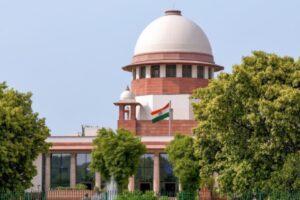



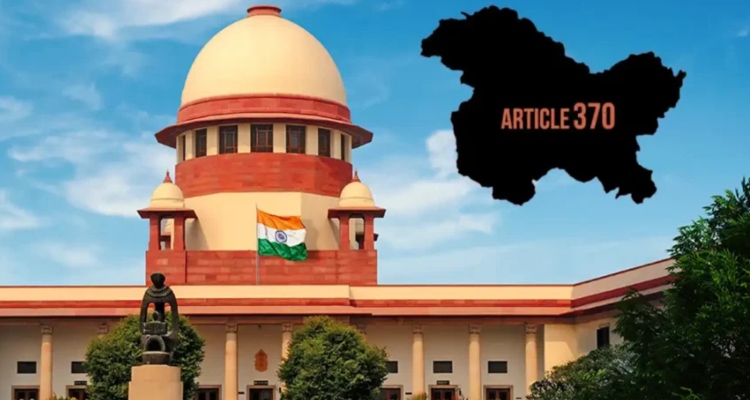
The Supreme Court to hear on August 8 a petition seeking directions to the Centre for restoring statehood to Jammu and Kashmir, 6 years after Article 370 was abrogated.
The matter was mentioned on Tuesday by senior advocate Gopal Sankaranarayanan before a bench comprising Ex Chief Justice of India DY Chandrachud and Justice K Vinod Chandran. “The date on the website shows August 8. Let it not be deleted,” the counsel urged.
The CJI agreed to retain the listing.
Background
The hearing comes nearly 8 months after the Supreme Court upheld the 2019 revocation of Article 370, which stripped Jammu and Kashmir of its special status. In its December 11, 2023 ruling, the apex court had directed the Centre to hold assembly elections in J&K by September 2024 and ensure restoration of statehood “at the earliest”.
Fresh Plea Cites Delay, Lack Of Timeline
The current application—filed by academician Zahoor Ahmad Bhat and activist Khurshaid Ahmad Malik—accuses the government of failing to act on the court’s directions. It stresses that no timeline has been provided for restoring statehood, despite the court’s instructions.
The petition warns that prolonged delay “undermines democratic federalism,” a core part of India’s constitutional structure, and deprives citizens of their rights to an elected government.
The plea also points out that both the Assembly and Lok Sabha elections were conducted peacefully in the region, with no incidents of violence or security threats, undercutting any argument for continued Union Territory status.
It contends that Jammu and Kashmir has now been governed as a Union Territory for nearly 5 years, causing “grave developmental and democratic losses.”
Call For Stronger Federal Structure
Citing J&K’s unique cultural identity and complex history, the petition argues for a strong federal structure and state-level autonomy to facilitate development and preserve its distinctiveness.
In its 2023 verdict, the Supreme Court had held that Article 370 was always intended to be temporary, and could be revoked by the President of India, especially in the absence of the state’s Constituent Assembly, which ceased to exist in 1957.
Read More: Supreme Court, Delhi High Court, States High Court, International