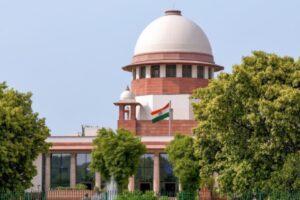



The Supreme Court on Tuesday outlined a fixed schedule to hear the Presidential Reference concerning the constitutional powers of Governors and the President when dealing with state legislation.
The hearings will begin on August 19, focusing on whether judicial deadlines can be imposed for action on bills passed by state assemblies.
Bench Finalizes Hearing Calendar
A five-judge Constitution Bench, led by Chief Justice D.Y. Chandrachud and including Justices Surya Kant, Vikram Nath, P.S. Narasimha, and A.S. Chandurkar, has asked both the Central Government and state governments to file their written arguments by August 12.
The bench emphasized adherence to deadlines, stating that preliminary objections, particularly from Tamil Nadu and Kerala, will be taken up first in a one-hour session on August 19. These states have challenged the very basis of the Presidential Reference, arguing that it may not be legally maintainable.
Hearing Schedule Breakdown
The court allocated specific dates for both sides of the debate,
- August 19, 20, 21, and 26 – Hearing of arguments from the Centre and states supporting the Reference.
- August 28, September 2, 3, and 9 – Arguments from states opposing the Reference.
- September 10 – Reserved for rejoinders and final clarifications, if needed.
Context
The issue stems from the Supreme Court’s April 8 verdict, which addressed Governor inaction on bills passed by state legislatures. That ruling for the first time stated that once a Governor sends a bill to the President for consideration, the President must act within 3 months.
Following this, President Droupadi Murmu, in May, invoked Article 143(1) of the Constitution—an article that allows the President to seek the Court’s opinion on questions of law or fact of public importance. The reference posed 14 constitutional questions related to the powers of the President and Governors under Articles 200 and 201.
Core Questions Before The Court
Among the key questions is whether the courts can set time limits on how long the President or Governors can take to decide on bills. The Supreme Court had previously ruled that Governors must act based on the advice of their state’s council of ministers and cannot exercise personal discretion in such matters.
It also clarified that if the President withholds assent to a bill sent by the Governor, the state government has the right to approach the Supreme Court for relief.
On July 22, the top court noted that the outcome of this case would have a nationwide impact, as the issues go to the heart of federalism, the division of powers, and the functioning of constitutional authorities.
The hearing is expected to bring clarity on the balance of power between elected state governments and constitutional heads.
Read More: Supreme Court, Delhi High Court, States High Court, International